Friday, 19 April 2013

Andean Cock-of-the Rock


An absolute highlight, at a point when I didn't think I was going to be able to go on ( but knew I had no choice), collapsed by the stream as Roberto cooked rice especially for my wonky tum, I looked up to see one of the birds that I have dreamed of for years - the Andean Cock-of-the-Rock. And what a cock he is - extraordinary colour and this eye that just dances around looking at you. He and his mate spend about 20 mins cavorting - I didn't even have to get up from the half-dead prone position! Man!
Our photos weren't good enough, so we pinched someone else's - -


On our way down


As we descended, first night at 3600metres, we passed the tree line and the farther down we went, the greener, lusher, damper, warmer and more humid it became. The first night was below zero - our tent and sleeping bags were as snug as can be, and the long johns  were helpful every night, but it became more pleasant.
2nd and 3rd nights at about 2600 feet, so the effects of altitude are gone. Bloody steep hills just the same!
My feet were killing me - both little toenails are gone, and the boys very kindly carried my gear.
Spectacular country though, with waterfalls, lush growth and no bugs!


My hero

We didn't meet many other people along the way at all, a couple of other hikers and just a few locals. This extraordinary women was on her way to La Paz for supplies. We passed her house two days further on, so she had been walking for at least three days - uphill all the way! She would get her supplies, have llamas waiting for her to help her bring them home. Note the radio in her hand.


Who was I kidding?


When we first met our guide for the trek I made a grand statement of ' the reason we are taking four days is that we are bird watchers and like to stop and look at everything along the way'.

Who did I think I was kidding? The reason for four days was because I am unfit, overweight and slow. I used to blame short legs, but can't even do that now - every local along the way had shorter legs then me and they were going uphill just fine!
It didn't help that I had diarrhoea for the first three days and wasn't eating, but still no excuse!
57 km or so, the El Choro Trek goes from the peak of 4850 metres down to 1200 metres at the bottom. It sounds easy, downhill all the way, but tell your knees and little toes that!

A pre-Inca road carved along the edges of the mountains, either going around the precipitous slopes or going down to the bottom of a deep valley, crossing a river, and then climbing up the other side again.

Started extremely high in the icy winds at 4850 metres and started downhill. Still ice around at 10 am when we got underway.


Friday, 12 April 2013

Hiking in the hills around Potosi

Our hacienda produces it's own electricity from a hydro station which used to supply the city but has since been nationalised by  the socialist government, plus cheese, yoghurt, wine, meat and all their fruit and veggies. The local villages support and are supported by the hacienda.

The countryside is spectacular and the villagers friendly. Every single person says good morning and you just wander through the hills. We are feeling rather humbled by the genuine openness and generosity of spirit of the people we are meeting.


Still puffing and panting up these hills, but must be improving soon! All in preparation for the huge 4 day trek in a day or so - - - - - 


Hacienda Cayara


From Sucre we hired a driver to take us to Potosi to a very odd Hacienda out in the country, that we'd heard about from an American in La Paz.
Potosi has (had) enormous reserves of silver and basically bankrolled the Spanish from it's  discovery in 1545. The Spanish monarchy relied entirely on this hill of silver 'Cerro Rico' for it's wealth and opulence, using slave labour from Africa to work in appallingly dangerous  conditions.
It became the wealthiest city in the Americas until the silver more or less dried up, and now there are small cooperative mines dotted all over the hillside, eking out a meagre living, still in very dangerous conditions.


Our Hacienda Cayara is 20 km out of town and dates back from those colonial times, being owned by some Maquis or another who eventually(childless) sold it an English/French/Spanish family in the early 1900's, leaving scattered buildings full of antiques, books, paintings, furniture etc which the current custodian Alturo is still cataloging and restoring.


The private chapel has only been unearthed in the last year or so and they are still discovering all sorts of things.  Restoration of the chapel is nearly complete one -they employ a full time professional restorer to work on it. They opened up as a hotel in 1992 and now well received by such groups as CondeNaste and business is going well. The library is extraordinary including priceless collections dating back 400 years.


We didn't even bother going into town - just walked in the hills for hours each day. We experienced the most amazing hospitality from the hosts, the staff and their visitors - much whiskey and wine and hugs and kisses by the end of the stay. 

Tuesday, 9 April 2013

Sucre

Today we moved on from the frenetic and noisy pace of La Paz, flying to the constitutional capital of Sucre - World Heritage listed, with beautiful buildings, spacious streets and the women are taller, less rural in appearance and bowler hats have been replaced by boaters. The countryside is stark and beautiful with extremely steep hillsides. The 35 min flight was the alternative to a 8 hr bus trip.
The city is UNESCO listed, is full of whitewashed churches, museums and public buildings and is surrounded by  parks.


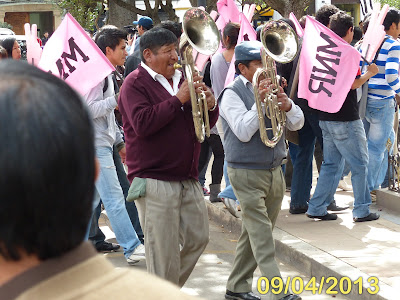
 Very beautiful and calm, it is a university town so young, stylish and modern in feel. There is also a series of protests been held in the main square - university conditions, markets prices etc. Lots of noise, music and fireworks for the morning but everyone goes home for siesta.


The indigenous women wear their traditional clothes with pride.
Local food is good - fresh orange juice on very corner, set  3 course lunches for about $4, food markets with homemade cheeses, breads and the nicest fresh fruit and veg. Our custard apples are nowhere near as good. Hard to find a beer without going to a 'gringo' bar, but we can survive!