Back to Quito for a couple of days after the rainforest and before our week at Tandayapa Bird Lodge. These are the guys who offered us the job, so it is going to be interesting to see what we think of it. Seriously birdy - that's for sure.
A day at the famous Otovalo markets yesterday - famous for textiles and weaving, so very hard to keep the hands in the pockets. Saturday is also animal market day where people trade everything from cows to guinea pigs and chickens. Not all cooperative, as one of the photos below shows - - .
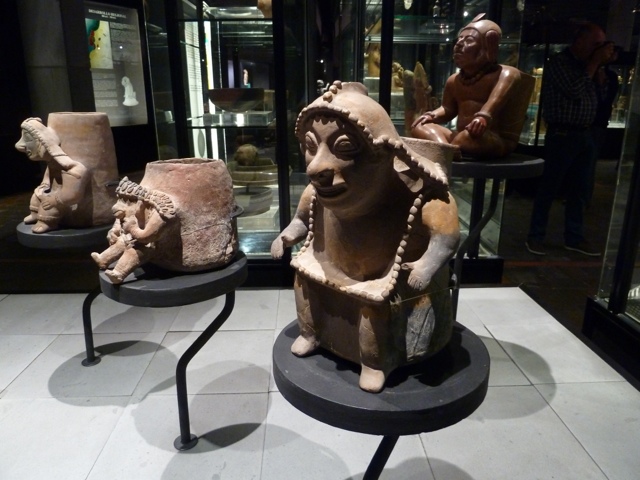
A visit to the national museum today, which has a wonderful collection of pre-Hispanic art - ceramics and metals mainly, with great examples of beaten gold from inca times and much earlier. Some of my favourite art.
Again, lucky enough to be here on a Sunday, so music and parades of traditional dance and costumes, and people everywhere. A really nice user-friendly city Quito - all transport is 25 cents, no matter how far you go, and every Sunday is family day. Can't ask for much more!
We are doing South America incrementally - - 3 months in Argentina and Chile in 2009/10 and now six weeks in Bolivia and Ecuador. We're still missing out on the 'big-ticket' items like Machu Picchu, Galapagos Islands and the Pantanal, so I guess at least one more trip to South America is one the cards in the not-too-distant future!
Sunday, 28 April 2013
Ecuadorian Amazonia
The magical sounding Amazon Basin!
How nice to be able to compare and contrast our own tropical rainforest in Daintree to that of the awe-inspiring Amazon.
The similarities are amazing - the structure of the rainforest, the vines, the orchids, the palms, the epiphytes, the cauliflory fruiting for pollination by bats, the huge canopy trees, the buttress roots, the richness of plant species, the butterflies, the birdlife.
The most noticeable differences, though, are the species themselves, including bromeliads, kapok trees and enormous fruiting palms. There are flooded forests, tannin-rich blackwater lakes, harmless caiman rather than crocs, several species of monkeys, toucans, macaws, woodpeckers, piraña, boa constrictors, poison dart frogs etc, etc, etc.
Most striking is the familiarity of so many of the plants - you realise that half the plants in your garden originate from the Amazon!! And look how tall they can get!!
Also is the knowledge that when you look to the east, the rainforest continues for millions of square miles. While that is encouraging - it is the earth's lungs after all - the rate of deforestation and the amount of oil drilling that is going on is threatening this resource. They say there is probably only 20 years of oil left in the Amazon in Ecuador, but there certainly appears to be a big push to get it while you can, and to keep exploring for more.
We are told that 50% of the Ecuadorian budget is from Amazonian oil. The new socialist government is working hard to replace this dependency and roses, funnily enough, have become the country's third biggest earner and they are working on other industry and tourism to fill in the gaps.
Our stay was at Sacha Lodge, one of the oldest lodges perched on the edge of a black water lake where you can both swim with and fish for piraña. We did both!
You share your time with a guide and local paddler/guide in a small group. In our case, as birders, we had the head guide Oscar, his son Oscar and local guide Jaime and a lovely English/Sth African couple from New Zealand who were also birders. Oscar was fabulous - local Chichewa names, English names, scientific names and a great eye and ear. Also a good laser pointer which we couldn't have done without in the dense rainforest.
It is very intense - up at 5 am every morning to get going, home for a rest after lunch and then out again in the canoes from about 4pm. Well organised, but a little Germanic at times. (The owners are Swiss). Who would ever think of having a full staff meeting at 7 pm when you have 20 people at the bar clambering for a pre-dinner drink?
They own 2000 acres of forest, mostly primary, and have a huge canopy tour which straddles a 45metre kapok tree and can be a little vertiginous, plus an aerial walkway which is 270 m long and 60 m high. Fabulous birding from the top early morning as the fog lifts to reveal toucans, barbets, antbirds, woodpeckers, fruit crows, cotingas and many more.
Canoes take you through a labyrinth of creeks and waterways with great names like Anaconda - no luck with wrestling (or seeing) an anaconda!
All in all a fabulous time - 130 or so species of birds, 4 of monkeys and zillions of other little critters. It was a great rainforest experience.
How nice to be able to compare and contrast our own tropical rainforest in Daintree to that of the awe-inspiring Amazon.
The similarities are amazing - the structure of the rainforest, the vines, the orchids, the palms, the epiphytes, the cauliflory fruiting for pollination by bats, the huge canopy trees, the buttress roots, the richness of plant species, the butterflies, the birdlife.
The most noticeable differences, though, are the species themselves, including bromeliads, kapok trees and enormous fruiting palms. There are flooded forests, tannin-rich blackwater lakes, harmless caiman rather than crocs, several species of monkeys, toucans, macaws, woodpeckers, piraña, boa constrictors, poison dart frogs etc, etc, etc.
Most striking is the familiarity of so many of the plants - you realise that half the plants in your garden originate from the Amazon!! And look how tall they can get!!
Also is the knowledge that when you look to the east, the rainforest continues for millions of square miles. While that is encouraging - it is the earth's lungs after all - the rate of deforestation and the amount of oil drilling that is going on is threatening this resource. They say there is probably only 20 years of oil left in the Amazon in Ecuador, but there certainly appears to be a big push to get it while you can, and to keep exploring for more.
We are told that 50% of the Ecuadorian budget is from Amazonian oil. The new socialist government is working hard to replace this dependency and roses, funnily enough, have become the country's third biggest earner and they are working on other industry and tourism to fill in the gaps.
Our stay was at Sacha Lodge, one of the oldest lodges perched on the edge of a black water lake where you can both swim with and fish for piraña. We did both!
You share your time with a guide and local paddler/guide in a small group. In our case, as birders, we had the head guide Oscar, his son Oscar and local guide Jaime and a lovely English/Sth African couple from New Zealand who were also birders. Oscar was fabulous - local Chichewa names, English names, scientific names and a great eye and ear. Also a good laser pointer which we couldn't have done without in the dense rainforest.
It is very intense - up at 5 am every morning to get going, home for a rest after lunch and then out again in the canoes from about 4pm. Well organised, but a little Germanic at times. (The owners are Swiss). Who would ever think of having a full staff meeting at 7 pm when you have 20 people at the bar clambering for a pre-dinner drink?
They own 2000 acres of forest, mostly primary, and have a huge canopy tour which straddles a 45metre kapok tree and can be a little vertiginous, plus an aerial walkway which is 270 m long and 60 m high. Fabulous birding from the top early morning as the fog lifts to reveal toucans, barbets, antbirds, woodpeckers, fruit crows, cotingas and many more.
Canoes take you through a labyrinth of creeks and waterways with great names like Anaconda - no luck with wrestling (or seeing) an anaconda!
All in all a fabulous time - 130 or so species of birds, 4 of monkeys and zillions of other little critters. It was a great rainforest experience.
Quito, Ecuador
What a contrast - from bustling, chaotic, stinky, loveable, steep La Paz to a brand new airport (only open a few weeks) and the modern, glitzy buildings, wide avenues and clean streets of Quito. Only thing is, they forgot to build a new road to the airport, so after about 20km you are back into winding, steep, smelly streets! Same, same but different, as they say!
We'd booked a package which included four nights out in an Amazonian Lodge and two nights either side in a B and B in Quito. A gorgeous little place full of antiques, paintings, fresh flowers and fireplaces ( very handy at night). Also in the package was a half-day walking tour in the old colonial city and, then when we get back, a full day visiting the famous indigenous markets at Otavalo, which I'm looking forward to.
It's a lovely city, towered over by the volcano Pichincha, and the worlds first city to be given UNESCO World Heritage Site status. Awash with historic churches from the early Spanish times - there are 86 in the historic centre, all of which are well used, most of which are extremely ornate, and most of which have huge underground crypts for the wealthy. It's a bit like an amusement park underground in some. The half day walking tour was great - a young man, enthusiastic and patriotic, with a nice sense of humour.
Fortunately Sunday has become people's day and they have blocked off the streets to traffic and opened them as cycle paths. Absolutely everyone does the 40 km lap through the streets every Sun am, then hangs out in the squares and parks for the day listening to music, eating, drinking etc. A delight!
We'd booked a package which included four nights out in an Amazonian Lodge and two nights either side in a B and B in Quito. A gorgeous little place full of antiques, paintings, fresh flowers and fireplaces ( very handy at night). Also in the package was a half-day walking tour in the old colonial city and, then when we get back, a full day visiting the famous indigenous markets at Otavalo, which I'm looking forward to.
It's a lovely city, towered over by the volcano Pichincha, and the worlds first city to be given UNESCO World Heritage Site status. Awash with historic churches from the early Spanish times - there are 86 in the historic centre, all of which are well used, most of which are extremely ornate, and most of which have huge underground crypts for the wealthy. It's a bit like an amusement park underground in some. The half day walking tour was great - a young man, enthusiastic and patriotic, with a nice sense of humour.
Fortunately Sunday has become people's day and they have blocked off the streets to traffic and opened them as cycle paths. Absolutely everyone does the 40 km lap through the streets every Sun am, then hangs out in the squares and parks for the day listening to music, eating, drinking etc. A delight!
Friday, 19 April 2013
Lake Titicaca
A dream of mine for many years, Lake Titicaca forms the border between Peru and Bolivia and is the world's highest navigable lake at 3800 metres. It is monstrous and extremely picturesque, being somewhat reminiscent of sitting on the edge of the Mediterranean while you mull over a beer at night.
It has been revered by numerous cultures over thousands of years as a sacred site and the Incas believed that the Sun God was born here on the Isla del Sol, and the Moon God on Isla de Luna, both just off the shore from where we are staying in Copacabana.
When we first arrived in Bolivia there was a prolonged strike in this area, with no access, so it has been great to finish up our time in Bolivia at Titicaca. The weather has been stunning - we have been very lucky. Must be the offerings we made to the Sun God!
Off to Ecuador tomorrow, which is great, but we are very aware of how much we have enjoyed Bolivia and how much more time is needed to see it well. Next year!!
Below are a few snaps of the lake - just beautiful.
It has been revered by numerous cultures over thousands of years as a sacred site and the Incas believed that the Sun God was born here on the Isla del Sol, and the Moon God on Isla de Luna, both just off the shore from where we are staying in Copacabana.
When we first arrived in Bolivia there was a prolonged strike in this area, with no access, so it has been great to finish up our time in Bolivia at Titicaca. The weather has been stunning - we have been very lucky. Must be the offerings we made to the Sun God!
Off to Ecuador tomorrow, which is great, but we are very aware of how much we have enjoyed Bolivia and how much more time is needed to see it well. Next year!!
Below are a few snaps of the lake - just beautiful.
Last day
Finally on our way down again towards a hot shower and a good bed.
Beautiful, beautiful countryside it's amazing how many of our common garden plants come from this lovely cloud forest habitat. The diversity is huge and just watching the clouds come in every day, making it moist and cool, then off it goes and in comes the sun, making it warm and dry. Perfect growing conditions. Our first real cloud forest experience.
All in all a wonderful time, but I did have my doubts- - - - !!
Beautiful, beautiful countryside it's amazing how many of our common garden plants come from this lovely cloud forest habitat. The diversity is huge and just watching the clouds come in every day, making it moist and cool, then off it goes and in comes the sun, making it warm and dry. Perfect growing conditions. Our first real cloud forest experience.
All in all a wonderful time, but I did have my doubts- - - - !!
Andean Cock-of-the Rock
An absolute highlight, at a point when I didn't think I was going to be able to go on ( but knew I had no choice), collapsed by the stream as Roberto cooked rice especially for my wonky tum, I looked up to see one of the birds that I have dreamed of for years - the Andean Cock-of-the-Rock. And what a cock he is - extraordinary colour and this eye that just dances around looking at you. He and his mate spend about 20 mins cavorting - I didn't even have to get up from the half-dead prone position! Man!
Our photos weren't good enough, so we pinched someone else's - -
On our way down
As we descended, first night at 3600metres, we passed the tree line and the farther down we went, the greener, lusher, damper, warmer and more humid it became. The first night was below zero - our tent and sleeping bags were as snug as can be, and the long johns were helpful every night, but it became more pleasant.
2nd and 3rd nights at about 2600 feet, so the effects of altitude are gone. Bloody steep hills just the same!
My feet were killing me - both little toenails are gone, and the boys very kindly carried my gear.
Spectacular country though, with waterfalls, lush growth and no bugs!
Subscribe to:
Posts (Atom)